Why Second-Generation Brides Style Indian Jewelry Differently in the USA
Picture two brides, a mother and her daughter, looking at the same family jewelry box. The mother sees pieces meant to be worn fully, head to toe, exactly as her own mother wore them. The daughter sees something else. She grew up between two countries, and her eyes read those same pieces through an American closet. That gap is real, and it shapes how Indian jewelry in the USA actually gets worn now. The old Indian antique jewelry still matters to her, deeply, but she wears it on her own terms.
Why Indian Antique Jewelry Means Something Different Now
For the older generation, the heavy set was the whole point. You wore it completely, or you did not wear it at all. Skipping a piece felt like skipping respect. The second-generation bride loosens that rule. She might wear her grandmother’s Indian antique jewelry as a single statement and leave the rest in the box. The meaning stays, but the styling shifts. She is not rejecting the heritage. She is fitting it into a life that runs on different clothes and different days.
How Indian Jewelry in the USA Meets a Western Wardrobe
Here is the real difference. The mother paired her jewelry with saris and lehenga, full stop. The daughter pairs the same pieces with whatever hangs in her closet, and a lot of it is Western.
A pair of old jhumkas over a slip dress. An heirloom choker against a plain blouse. Indian jewelry in the USA now sits beside denim, blazers, and gowns, not only traditional wear. That mixing used to feel wrong to an older eye. To the younger bride, it feels honest because it matches the life she actually lives.
Wearing Less, but Wearing it More Often
The older approach saved jewelry for big occasions. Two or three outings a year, then back in the locker. The newer approach flips that completely.
A second-generation bride would rather wear one antique piece often than a full set rarely. She pulls a single bangle or a pair of studs into a normal week. The logic is simple. A piece that lives with you means more than a piece that waits in the dark. Perhaps that is the biggest shift of all, treating heritage as something to use rather than guard.
Mixing Old Pieces With New Ones
This generation has no problem blending eras. A modern stud in one ear story, an antique drop for evenings, all sitting in the same collection without conflict.
A few ways that blending shows up:
- An antique pendant hung on a new, simpler chain.
- Old earrings worn with a current minimal ring.
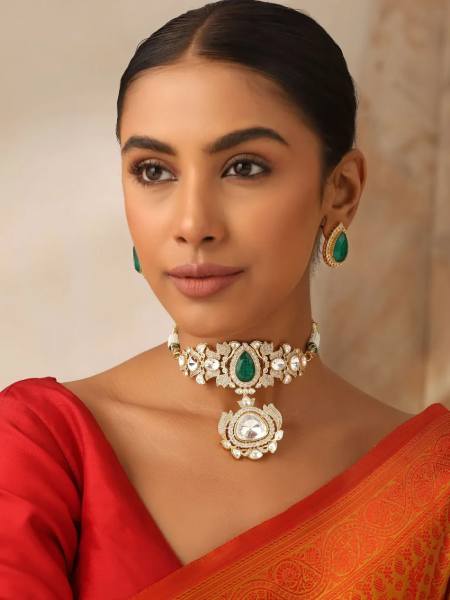
- A single heritage choker styled against a sleek, modern outfit.
The point is not to keep old and new apart. The point is to let them share a wardrobe, the way the bride herself shares two cultures. That comfort with mixing is something the older generation rarely had room for.
Keeping the Story Without Keeping the Rules
The fear, often unspoken, is that loosening the rules loses the heritage. That wearing a piece casually somehow cheapens it. I think the opposite tends to happen.
A piece worn often, loved openly, carries its story further than one locked away. The second-generation bride keeps the meaning while dropping the rigid script around it. She tells her grandmother’s story in her own voice, with her own clothes. The heritage does not fade. It just learns to speak American English without forgetting where it came from.
Featured Image Source: https://www.myrivaaz.com/cdn/shop/files/necklaces-arza-antique-gold-victorian-choker-arza-emerald-antique-gold-victorian-choker-my-rivaaz-indian-jewelry-1208830384.webp?v=1764292447&width=1100
