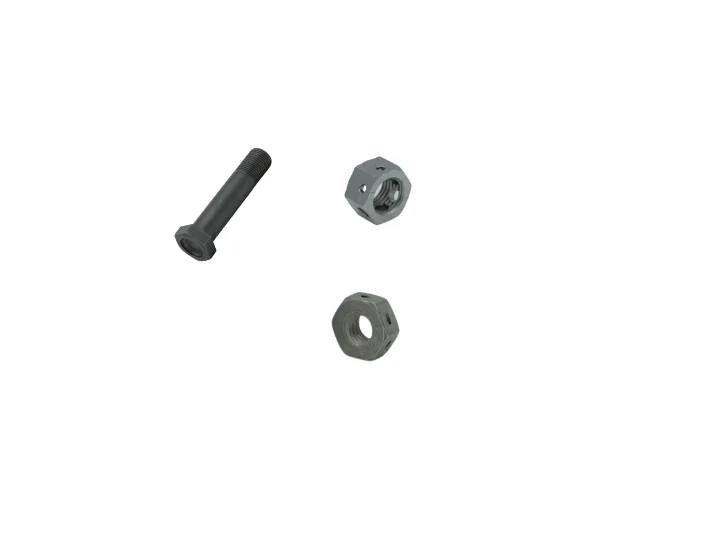
Composilok Fasteners: What Aerospace Fastener Manufacturers Need To Know About Composite-Locking Technology
The mechanics of how composite-locking works matter more than most aerospace fastener manufacturers realise. Understanding the technology prevents costly mistakes in specification and application. Composilok fasteners solve vibration loosening through a specific approach. Understanding that approach means knowing when to use Composilok and when to consider alternatives. The composite material, how it engages threads, and how it behaves over time shape what manufacturers can expect.
How Composite-Locking Material Actually Functions
Composite-locking material sits inside the fastener, typically in the threaded portion. When the fastener tightens, the composite material compresses slightly. This compression creates friction between the fastener and the mating threads. The friction resists rotation, which prevents loosening. Here is the key distinction: Composilok fasteners work through friction, not mechanical interference. This matters for several reasons.
The composite material remains flexible enough to accommodate thread variations and surface irregularities. This flexibility allows the fastener to seat properly regardless of minor deviations in hole machining or thread condition. A rigid locking mechanism might jam or require excessive torque. Composilok fasteners adapt while still providing locking force.
Temperature Effects on Composite Material
Aerospace environments expose fasteners to extreme temperature swings, which is why aerospace fasteners companies must engineer components for these demanding conditions. Ground temperature might sit at 60 degrees Fahrenheit. At altitude, external surfaces reach negative 60 degrees or colder. The composite material in Composilok fasteners changes properties with temperature, but not drastically. The material remains pliable at low temperatures and doesn’t soften excessively at high temperatures.
This temperature stability differs from that of nylon-insert lock nuts. Nylon degrades when exposed to sustained heat or certain solvents. The composite material in Composilok fasteners resists both thermal degradation and chemical attack. An aerospace fastener manufacturer specifying Composilok can be reasonably confident the fastener will perform across the expected temperature range.
Disassembly and Reuse Characteristics
Composilok fasteners can be removed and reinstalled, though reassembly differs from initial assembly. The composite material partially compresses during the first tightening. When removed, the material springs back but doesn’t fully recover. Reinstallation generates less locking force than the original assembly.
This degradation matters. An aerospace fastener manufacturer planning multiple disassembly cycles needs to account for reduced locking force. Some applications tolerate this change. Others cannot. The design process should address this explicitly.
Torque Specifications and Control
Composilok fasteners require proper torque control for optimal performance. Too little torque leaves the composite material partially compressed. Too much torque deforms the material excessively and wastes the fastener’s locking capacity. The fastener manufacturer typically provides a torque range. Staying within that range matters significantly.
Here is something less obvious: the friction created by composite-locking changes the torque angle relationship. Standard fasteners follow predictable torque curves. Composilok fasteners deviate slightly because the composite material absorbs some of the rotational force. Installation procedures should account for this.
Specification Reality
Composilok fasteners work well when properly specified and installed. They fail when installed into applications they weren’t designed for or when environmental conditions exceed their limits. An aerospace fastener manufacturer benefits from understanding the technology’s real capabilities rather than relying on marketing claims or oversimplified descriptions.
This knowledge shapes better design decisions and more reliable assemblies.
Featured Image Source: https://sp-ao.shortpixel.ai/client/to_auto,q_glossy,ret_img/https://upsind.com/wp-content/uploads/2024/12/aerospace-products.jpg
