What Separates a Truly Top-Rated Pizzeria from a Popular One
Few foods generate as many opinions per square mile as pizza. A single neighborhood can support a loyal following for a thin-crust slice counter, a wood-fired Neapolitan dining room, and a delivery shop that has operated for decades, and each can credibly claim to be the best. Star ratings, reader polls, and critic lists add to the noise. Some of that signal is useful, but much of it reflects who bothered to vote.
When readers search for a top rated pizza restaurant, they usually want more than a star average. They want to know whether a pizzeria performs well across several criteria: dough, sauce, topping quality, consistency, and service. Telling those apart requires understanding how ratings are produced, which styles a pizzeria is attempting, and what its broader menu reveals about the kitchen. The method below works for any pizzeria, whether it sits in a dense city or a suburb.
The same approach applies to a neighborhood operation such as The Tomato Shack salad & pizza co, Conshohocken, where a menu that pairs salads with pizza offers two points of comparison in one visit. Judging a restaurant this way means looking past the headline score to the evidence behind it.
How Ratings Are Earned, and Where They Mislead
Most best-of conversations draw on four signals: review platform scores, reader polls, critic lists, and awards. Each measures something different, and each has a predictable blind spot.
- Review platform scores aggregate many customers over time, which helps reveal consistency across visits. However, an average can reflect volume more than craft. A shop with 2,000 reviews at 4.4 may be more reliable than one with 60 reviews at 4.9, but the smaller shop may simply have a few devoted customers. Older reviews also persist, so a kitchen that changed chefs or ovens may still be judged by a previous version of itself.
- Reader polls favor neighborhood loyalty. ARLnow’s Arlington readers’ choice list, which ranks Pupatella, Wiseguy, and Andy’s among its top vote-getters, tells you which shops mobilize local voters, not necessarily which pies are most consistently made.
- Critic lists tend to favor novelty, unusual toppings, and chef-driven concepts. A critic may reward an inventive white pie more than a flawless classic Margherita.
- Awards are often narrow in scope and tied to a specific judging panel or category. They are useful signals but rarely comprehensive.
Because of these biases, a reliable reading of reviews depends on what you check. A simple checklist helps:
- Look for repeated mentions of crust texture, sauce balance, and topping quality rather than the overall star count.
- Separate complaints about wait times from complaints about the pizza itself. A long line signals demand, not necessarily a flaw.
- Weigh recent reviews more heavily than a decade of praise, especially after ownership or staff changes.
- Notice whether reviewers name specific pies. Repeated praise for one dish suggests a dependable signature.
- Compare platforms and polls. Agreement across sources is more informative than a single high score.
The Styles That Define a Great Pie
A pizzeria’s claim to quality is easiest to test against the style it says it serves. Readers often search by style, so understanding the technical markers helps separate craft from imitation.
Neapolitan and Wood-Fired Pies
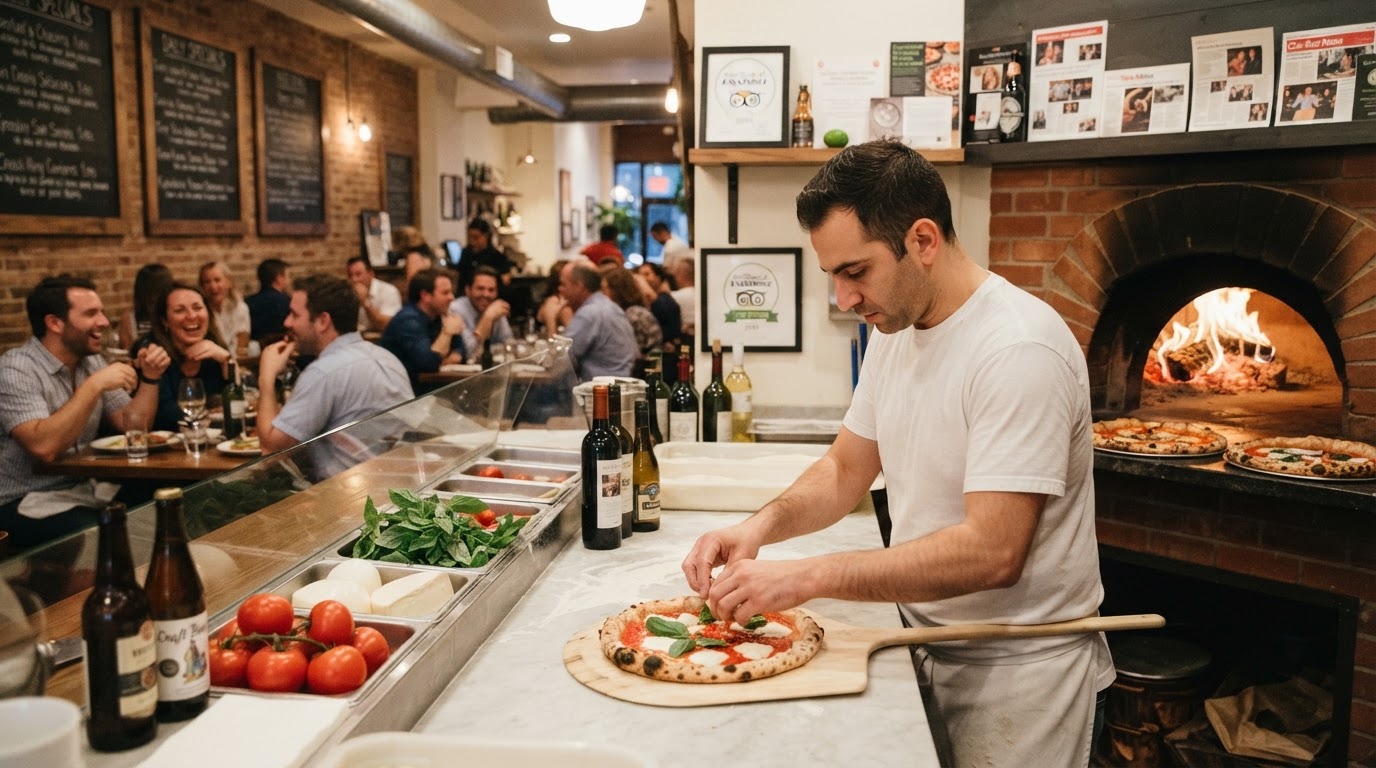
Neapolitan pizza depends on long fermentation and a very hot oven. The Associazione Verace Pizza Napoletana (AVPN) sets rules covering dough, ingredients, and oven construction. Ancora in New Orleans, for example, ferments its dough for three days and bakes it in under two minutes in a Neapolitan oven built in Naples. Margot’s, also in New Orleans, reports baking at 850°F.
Three markers matter most:
- Fermentation time: Neapolitan dough is typically fermented for many hours to several days, producing a soft, extensible dough with a slightly tangy flavor.
- Oven temperature: Traditional Neapolitan ovens run near 900°F, which allows a bake of about 60 to 90 seconds.
- Char pattern: Look for a puffed, blistered outer rim (the cornicione) with irregular dark spots, alongside a soft, moist center.
To judge whether a pizzeria follows the style closely or only borrows its look, ask whether it names its flour, fermentation schedule, or oven. A thin, uniformly cracker-crisp crust with little blistering often indicates a conveyor oven or a deck oven operating at a lower temperature, regardless of the menu description.
New York-Style and Foldable Slices
A foldable crust depends on flour with higher protein content, hand-stretched dough, moderate hydration, and a cold fermentation that often runs 24 hours or longer. Deck ovens typically bake these pies at high heat, producing a crust that is crisp underneath but pliable enough to fold without cracking along the center crease.
Slice-by-slice ordering changes the experience. Pizza is at its best within minutes of leaving the oven, so a slice pulled from a freshly topped pie differs noticeably from one that has sat under a heat lamp. Zee’s in New Orleans is described as serving crispy, foldable crusts that hold their shape, which is the standard to test. When possible, order from the pie just out of the oven and watch whether slices are cut to order.
Deep Dish, Sicilian, and Regional Variants
Sicilian and deep-dish pies are often confused, but they differ in dough and structure. Sicilian pizza is thick and rectangular, with a bread-like, focaccia-style dough that is proofed in an oiled pan. Sauce typically sits on top of the cheese and toppings. Deep-dish pizza, usually associated with Chicago, uses a shorter, sturdier dough pressed into a deep pan. Cheese layers beneath chunky tomato sauce, and the pie bakes longer to set the structure.
Midway in New Orleans serves its pies in a proper deep-dish pan, and the edges crisp in a way that reveals the dough’s handling. Regional adaptations also reveal how faithfully a kitchen treats a tradition. Zee’s, for example, brings the pepperoni cup, in which small pepperoni cook into curled, bowl-shaped slices that hold rendered fat. A pizzeria that adapts a regional idea with attention to its mechanics, such as the pepperoni’s thickness and cook time, shows more care than one that simply adds the name to a menu.
What to Look for on the Menu and in the Kitchen
A kitchen that takes pizza seriously shows it in the menu before the first pie arrives.
- A focused menu: A short list of pizzas, supported by a few well-executed starters, usually indicates control over prep and timing. Very long menus can point to frozen components or inconsistent execution.
- Seasonal or rotating specials: Pizza Delicious in New Orleans is known for changing its specials frequently, from an artichoke, bottarga, and fennel white pie to a braised pork pie with delicata squash. Rotation suggests the kitchen is testing ideas rather than repeating defaults.
- A signature pie: The best shops have a dish that is more than a default option. Johnny’s Sweep the Kitchen, loaded with 11 toppings, is a regional example of a signature built around a clear identity.
The fundamentals are less visible but easier to test:
- Dough handling: Look for hand-shaped dough and a visible rest period. Par-baked crusts and pre-formed discs signal shortcuts.
- Sauce balance: A good sauce tastes bright and tomato-forward, with acidity that cuts the cheese. Overly sweet or heavily seasoned sauces often mask weak tomatoes.
- Topping quality: Cured meats, cheeses, and vegetables should taste distinct. Ancora’s house-made salumi selection is an example of a kitchen that makes components rather than buying them finished.
Accommodations also indicate planning. Vegetarian and vegan options that appeal beyond a single diet are a good sign. Pizza Delicious offers vegan options on rotation that, by the restaurant’s account, also appeal to omnivores, which reflects a kitchen designing for the whole table.
Non-pizza items serve as a final check. Salads, antipasti, and sides use the same ingredients and often reveal more about a kitchen’s standards than the pizza does. A dressing that tastes made in-house, or a side of roasted vegetables that is properly seasoned, suggests the same attention is applied to the oven. Pizza Domenica’s wood-roasted cauliflower and Oak Oven’s house-made pastas are examples of non-pizza dishes that carry the kitchen’s reputation.
Local Gems, Statewide Institutions, and Chains
Strong pizza tends to cluster in dense food cities. Foot traffic, competition, and long-established immigrant baking traditions all sustain a wide range of shops. The Greater New Orleans area, the most populated and restaurant-dense region of Louisiana, offers the widest variety of pizza styles in that state. Suburban communities near large cities often have a similar, if smaller, mix, with shops competing for a local audience while drawing from the regional market.
Smaller towns can work differently. Johnny’s Pizza House, which started in Monroe in 1967, has grown into a multi-state chain, but it still earns deep local loyalty. Its regional status shows how a single standout can become a point of pride for the community that defends it.
Independent neighborhood spots and multi-location chains require different ratings. Chains can be consistent and convenient, and their standardized recipes make them easy to predict. The question is whether the average reflects the location you will visit. Each branch has its own staff, oven, and management, so reviews of individual locations matter more than a brand-wide score. Independents offer more variability and chef-driven choices, which can bring both exceptional results and inconsistency.
To use local rankings effectively:
- Treat a list as a shortlist, then check recent reviews for the specific location.
- Plan around demand. Pizza Domenica’s Magazine Street location is known for noise and waits, and Pizza Delicious expects guests to stand in line to order.
- Consider takeout or off-peak visits when a dining room is crowded. Pizza often holds quality best when it is eaten soon after baking, so ask how long a takeout order takes to leave the oven.
- In suburban areas such as Conshohocken, Pennsylvania, which sits within a short drive of Philadelphia’s dense pizza market, compare local options against the broader regional scene before deciding.
Reading the Rankings: Common Questions Behind the Search
Readers bring predictable questions to best-of lists. The most useful answers frame quality around criteria rather than a single winner.
Which pizzeria is considered the best in the world? There is no universal ranking that settles this. The answer depends on the style being judged. A Neapolitan shop following AVPN-style rules is measured against fermentation, oven temperature, and char. A New York-style slice is judged on foldability and crust balance. A Sicilian pie is measured on dough structure and proofing. Ancora shows what rule-bound Neapolitan craft looks like, while Johnny’s shows how a regional institution builds loyalty around a signature style.
What is a Sicilian pizza? It is a thick, rectangular pie with a bread-like, pan-proofed dough, usually topped with sauce after baking or after the cheese has set. Its structure, dough, and sauce placement distinguish it from deep dish and from thin-crust styles.
How does chain pizza compare with independent pizza? Chains typically compete on consistency, price, delivery reach, and customization. Independents often compete on ingredients, technique, and menu variety. A fair comparison looks at the same criteria: dough texture, sauce balance, topping quality, and whether the specific location delivers what its brand promises. Chain averages should be read location by location, while independents should be judged on recent performance and signature dishes.
Is Domino’s or Papa John’s pizza better? Both are national chains, and the answer depends on what you value. Compare them on dough consistency, sauce flavor, delivery speed, and value, and check reviews for the location that will serve you. Neither answer is universal.
A good ranking, then, is a starting point. Use the criteria in this guide to test any pizzeria: the style it claims, the fermentation and oven it describes, the consistency of its reviews, the focus of its menu, and the quality of its non-pizza dishes. That method is what separates a truly top-rated pizzeria from one that is simply popular.
